 |
Vitamin
D is one of the four fat soluble vitamins and one vitamin
that can be obtained through exposure to the sun. Vitamin
D is also nick named the sunshine vitamin for obvious reasons.
There are 5 forms of vitamin D, but only two are physiologically
relevant to us. Forms D2 (ergocalciferol) and D3(cholecalciferol)
are the two we use, and D3 is produced from our skin. Vitamin
D is carried in the blood to the liver where it is then
converted to calcidiol, which can then be converted in the
kidneys to the biologically active form of vitamin D called
calcitriol. Vitamin D inefficiency is most popularly linked
to osteoporosis and rickets. |
Vitamin
D and Bone Strengths:
Vitamin D plays a major role in building and maintaining strong
bones. Vitamin D increases bone strength by increasing the calcium
that is absorbed through your intestines, increasing osteoclast
(bone building) numbers, maintaining phosphate and calcium levels,
and helping the parathyroid hormone to maintain calcium levels.
Those that are deficient in vitamin D are at a high risk for lower
bone density, osteoporosis, and therefore are at a higher risk
for bone fractures.
Immune System and Vitamin D:
A study done at University of Copenhagen has come to the conclusion
that vitamin D aids T cells in our bodies. Without vitamin D
these cells will not be able to react to a foreign substance
and won’t be able to protect us. If someone is lacking
vitamin D their T cells will not be activated to attack a virus
or bacteria. If the T cells just lay dormant, than you will
have no line of defense to ward off an illness. Professor Carsten
Geisler from the Department of International Health, Immunology
and Microbiology, was quoted: “When a T cell is exposed
to a foreign pathogen, it extends a signaling device or ‘antenna’
known as a vitamin D receptor, with which it searches for vitamin
D. This means that the T cell must have vitamin D or activation
of the cell will cease. If the T cells cannot find enough vitamin
D in the blood, they won’t even begin to mobilize. ”
Be sure to be getting your vitamin D BEFORE you get ill.
Multiple
Sclerosis and Vitamin D:
Multiple Sclerosis or MS is a disease that results from the
body’s failure to recognize itself. The immune system
will then attack and destroy the sheath that protects nerves.
The body cannot distinguish between itself and a foreign substance
or infection. This turns the body’s normally effective
defense system against itself. Since vitamin D is an immune
system regulator people who spend more time outside have less
occurrence of MS. People living in regions where they can spend
time outside year round have a much less potential to get MS.
Vitamin D pills are now being used as a treatment for MS
Vitamin
D and Asthma Control:
According to a study, published in the American Journal of Respiratory
and Critical Care Medicine, done with 600 Costa Rican children
serum vitamin D levels were linked to asthma severity. The study
found that children who lad lower serum vitamin D levels were
more likely to have been hospitalized from asthma, and use more
inhaled medicine. There still needs to be more research on this
topic as the study was a simple epidemiological study.
Other
Benefits:
Vitamin D has been casually linked to other benefits such as
healthy brain aging, helping maintain a healthy body weight,
protection against low levels of radiation, and some studies
have shown that people with appropriate levels of vitamin D
are at lower risk to develop cancer.
Foods
with Vitamin D:
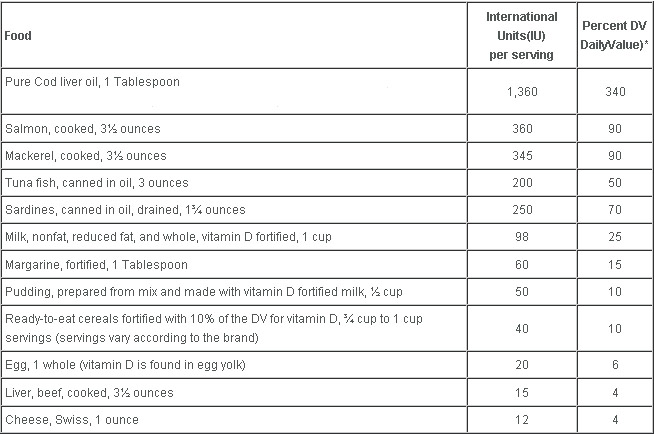
If you are not getting enough vitamin D by simply being outside
there are foods that you can get vitamin D from. Many foods
are now fortified with vitamin D like milk which was fortified
to help prevent rickets in the 1930s. Here is a list of foods
with vitamin D:
Vitamin
D Requirements:
Birth to 12 months – 400 IU
1-13 years – 600 IU
14-18 years – 600 IU
19-70 years – 600 IU
71+ years – 800 IU
Pregnant/Breastfeeding women – 600IU
Vitamin
D Supplements:
If you are usually active during the summer months it may be
a wise idea to start supplementing vitamin D during the winter
when you’re not getting vitamin D naturally from the sun.
You do not need to get your whole daily requirements from supplements,
but you can help reach that value with foods high in vitamin
D and supplements. The best plan of attack for obtaining enough
vitamin D is to balance your foods with vitamin D and your supplement
usage. Vitamin D supplements happen to be fairly cheap, so it’s
not a huge investment for some incredible health benefits. Here
are some examples of cheap effective vitamin D supplements!